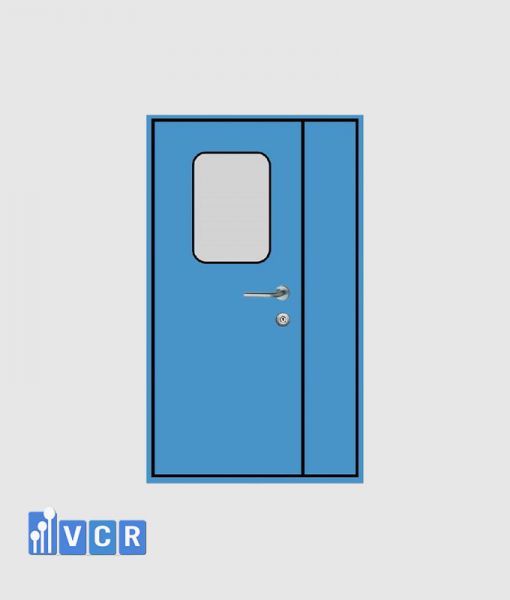
In real operations, “VCR Cleanroom Equipment” has found that most cleanroom door issues are not complex, but incorrect handling can affect the entire environmental control system.
Why does a cleanroom door fail to close tightly and how can it be fully resolved?
A cleanroom door that fails to close tightly is often caused by worn gaskets, misaligned frames, improper hinge adjustment, or unnoticed obstructions, leading to air leakage and loss of pressure control within the cleanroom. To resolve this completely, the entire contact surface between the door leaf and frame must be inspected, gasket condition evaluated, and any debris removed from sealing areas, while hinges or sliding systems are adjusted to ensure uniform pressure along the seal. If the gasket has hardened or deformed, it must be replaced immediately to restore airtightness. Proper resolution ensures environmental stability and prevents GMP deviations.
Why is a cleanroom door difficult to open or close and how can it be quickly checked?
Difficulty in opening or closing is typically caused by increased friction due to lack of lubrication, accumulated dust in sliding tracks, or misaligned hinges that have worn over time, affecting operation and increasing the risk of failure. A quick check involves observing the force required, listening for friction noise, and assessing the smoothness of movement to identify problematic areas. Cleaning, applying proper lubrication, and adjusting alignment can restore normal operation. Early intervention helps maintain performance and extends equipment lifespan.
Why does a cleanroom door produce abnormal noise during operation and how can it be fixed?
Abnormal noise usually indicates high friction, loose components, or wear in mechanical parts such as hinges, sliding rails, or fasteners, which not only affects usability but also signals potential failure risks. To fix this, all connection points should be checked and tightened, moving parts should be lubricated properly, and worn components should be replaced if necessary. Maintaining quiet operation improves reliability and helps detect issues early.
Why does a cleanroom door become misaligned and not fit the frame properly?
Misalignment is often caused by improper installation, structural deformation over time, or loosened hinges, resulting in uneven gasket contact and loss of airtightness. Correction requires checking frame alignment, tightening or adjusting hinges, and recalibrating the door position to ensure even sealing. Severe deformation may require structural reinforcement or replacement.
Why does a cleanroom door cause pressure loss in the system and how can it be controlled?
Pressure loss occurs when doors are not airtight, remain open too long, or are operated incorrectly, disrupting airflow and affecting the entire cleanroom system. Control measures include regular airtightness checks, operator training, and strict control of door opening duration. Proper management ensures environmental stability and minimizes contamination risks.
Why does the interlock system fail to operate correctly?
Interlock failure is usually related to sensor malfunction, signal interruption, or electrical connection issues, preventing proper door control. System diagnostics and electrical checks are required to identify and resolve the issue.
Why do door sensors fail to respond or respond incorrectly?
Sensors may be affected by dust, misalignment, or component failure, leading to inaccurate signals and unsafe operation. Regular cleaning and calibration help maintain proper function.
Why does a cleanroom door open or close unexpectedly?
Unexpected behavior is often caused by control system or sensor errors, requiring signal verification and system reconfiguration to ensure safe operation.
Why does a cleanroom door get stuck during operation and how can it be quickly resolved?
Door jamming may result from obstructions, misaligned tracks, or damaged mechanisms, requiring immediate inspection and correction to restore safe operation.
Why do cleanroom door gaskets become loose or ineffective?
Gasket failure is typically due to aging, improper installation, or wear, leading to reduced sealing performance and pressure instability, requiring timely replacement.
Why can a cleanroom door fail to remain closed?
This may be caused by weak closing mechanisms, loose hinges, or improper configuration, requiring adjustment or component replacement.
Why does a cleanroom door vibrate during operation and how can it be fixed?
Vibration is usually caused by loose structural components or incorrect installation, which must be corrected by tightening and realigning parts.
Why can cleanroom doors contribute to cross-contamination?
Improper operation, excessive opening, or uncontrolled movement flow can lead to contamination, requiring strict adherence to procedures and training.
Why do cleanroom door surfaces become damaged or scratched easily?
Surface damage is often due to improper handling or incorrect cleaning methods, requiring better operational control and appropriate cleaning practices.
Why does a cleanroom door have a shorter lifespan than expected?
Reduced lifespan is typically due to improper maintenance or incorrect operation, requiring improved maintenance planning and user training.
Why do cleanroom doors experience recurring issues?
Recurring problems often indicate that root causes have not been properly addressed, requiring a comprehensive system evaluation.
When should technical experts be called for cleanroom door issues?
Technical support should be engaged when issues affect pressure control, airflow, or exceed basic troubleshooting capabilities to ensure safety and compliance.
Can basic troubleshooting be performed before calling technicians?
Yes, basic checks such as sealing condition, movement performance, and sensor status can help identify initial causes before deeper intervention.
Should cleanroom operations be stopped when door issues occur?
In severe cases affecting environmental control, stopping operations may be necessary to prevent system-wide impact.
How can cleanroom door issues be minimized in long-term operation?
Minimizing issues requires a combination of routine maintenance, proper operator training, strict usage control, and immediate resolution of minor problems before they escalate, along with ensuring correct design, installation, and configuration from the beginning. A well-managed system ensures stable operation, reduces downtime, optimizes costs, and maintains compliance with ISO and GMP throughout the lifecycle.
Duong VCR